Showing posts with label SVO. Show all posts

Wednesday, August 21, 2019

Ryne

I just released a tech demo of Ryne, my game-engine-to-be. You can find more information and media on the Ryne Engine website.

Ryne is an experimental voxel pathtracer. You can try the tech demo yourself to see if it runs on your PC.

In the future I will release the C# scripting side open source. This will allow you to change most of the engine features yourself. You can see an overview of the functionality currently included in that project here. 


Why “release” it now?

I don’t want to create endless videos about a new technology that you will have to believe is real. Instead I’d like to include as many of you as possible while Ryne is in development. I know Ryne still has flaws and is nowhere near as usable as I want it to be, but I’m still convinced that putting out tech demos like these will bring the point across that we will get there eventually. This will both help me focus on the most important issues, and make everyone aware this is no longer a dream, but we can actually render something right now.

I’m trying to keep a stream of releases going out whenever I feel a new set of features or bug fixes are good to go.

If you’d like to discuss or have more questions, feel free to join the discord server.

Thursday, October 27, 2016

Master thesis current state

For my master thesis, I've been working on a project for some time now. In this post I'll share a few debug screenshots of the current state of the project.


The project can load triangle meshes of (almost) any format, and convert them to large resolution sparse voxel octrees (SVO). In the picture above, you can see the voxelized Lucy model, which is about 500MB in triangle format.

Converted to an SVO, storing only which voxels are on or off, we can store data for up to 4096^3 voxels in only ~40MB. That's a boolean for ~68 billion voxels. But since we only store voxels that are on, this number changes drastically, thus we are able to compress this pretty well.

If you want to store more data for every voxel, the amount of memory is going to skyrocket. In the example above, I store a scalar field for every voxel (that's 8 floating point numbers per voxel). All that data nets nearly 870MB for the highest resolution.

I was able to convert and draw a model up to 8192^3 resolution, including all simplifications of a dragon model:


Where you can see that the voxel resolution is even larger than the millions of triangles stored in the model.

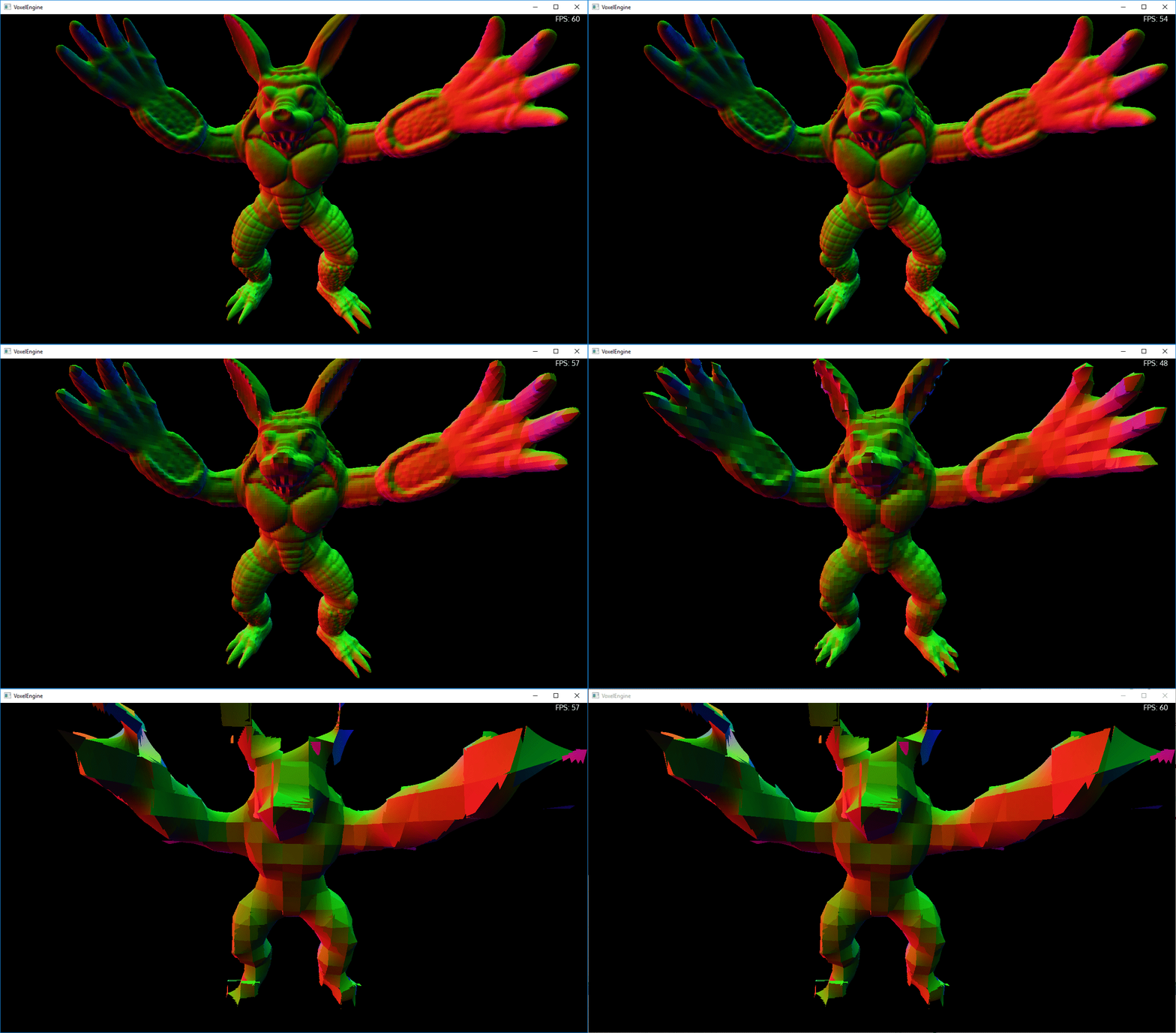
For my master thesis I will be working on creating level of detail simplifications. The screenshots below show some results of a linear approximation calculated for a group of voxels:


The first model at 512^3 resolution, and the second at 2048^3.

These images are rendered using raymarching to find the intersection point of a ray and a scalar field. I wrote the raytracer in CUDA, which allows for an interactive framerate even with gigantic data sets by using parallelization on the GPU.

Finally, some more renders: